

The DV Health Nook is Gray’s Trauma-Informed Care Services Corp’s Blog Corner. Here, there will be series dedicated to the stories of victims and survivors of trauma and domestic violence. We will provide analysis of systems at work within the stories. Finally, we will offer an aspirational look at the social change we want to see in the world.

Stories from the Field
“Stories from the Field” is a collection of real-life accounts shared by victim advocates, detailing journeys of domestic violence survivors—from their struggles to their paths toward safety and recovery. Each story offers insight into the systems survivors navigate and the resilience they embody. Please note: Some content may be disturbing, so viewer discretion is advised—but we encourage you to engage with these powerful narratives.
by
Dr. Amber D. Gray, DBH & Tabitha M. Chapman, MFT
Fall 2022: INSPIRING JANE DOE (Part of Shifting the Focus 2022 in Collaboration With the California Partnership to End Domestic Violence)
by Dr. Amber D. Gray, DBH
In 2007, I facilitated an empowerment group for women who were victims of domestic violence, sexual abuse, and early childhood trauma. This group was not to provide therapy for the women. It was an adjunctive to assist them in expressing their thoughts and feelings about themselves, their skills, and their future. Each morning, I brought the women coffee and donuts, a bit of caffeine and sugar rushes, to kick start the day. We’d gather the chairs into a circle as if they were in a share and tell.

During one morning’s facilitation, a woman I shall identify as Jane Doe was scheduled to read her paragraph about herself, her skills, and her potential future. Jane was a rough woman who had a difficult life. She rarely came to the group and did not like to talk in the group facilitation. Frankly, she rarely came to the facility at all. The day of her reading was surprisingly one of the days she did.
She scoffed at the idea of the assignment. She looked around the room, shaking her head. She gave me a look that let me know she was irritated with me. I smiled at Jane. “Whenever you are ready, Jane,” I said, encouraging her to speak. She rolled her eyes hard but stood up. She reached into her pocket, taking out a folded piece of paper. She unfolded it. She rubbed her face nervously and began to read from the paper.

“There is not much to say about me. My life was hard. It still is hard. Each morning, it’s the same old thing… how am I going to pay the bills? I hear my son crying from his bedroom. I want to scream. I don’t. I’m his mother. He didn’t ask to be here. I have to help him. I have no skills. Not sure that I do have a future. What gets me through my day is my boy. Cold, heat, snow, it doesn’t matter; I’m always here for my boy. I come to this group because there are things I learn sometimes. Not all the time. Some. It helps me get things done so that I can help my son. There is nothing else to say about me.”
After reading, Jane folded the paper and jammed it into her pocket. She sat down. A few women snickered at Jane’s reading, but most clapped. Jane muttered under her breath, “stupid ass assignment.” Other women had gotten up and read their paragraphs. When the group was over, I asked Jane to stay after. She slammed her fist against her thigh. It reminded me of a teenager in high school who was upset that they may have gotten in trouble. When the room cleared, I asked Jane to sit. She did. Before I could say anything, Jane started defending herself.
“This is a dumb assignment. I did my best. I have no skills. I have nothing. Don’t get me in trouble with the program. This is all I got. I’m learning to do stuff here. I told you I didn’t want to do this.”
I reassured Jane that she was not in trouble. I discussed her aptitude for tenacity and perseverance. I explained that she could be in a position of leadership if she shifted her focus a bit. I had Jane’s attention. I pointed out that in so few words, she had told a story that most women could relate to. Jane rubbed her brow with the sleeve of her sweater. The room we were in was stuffy and a little warm but tolerable. Jane smiled at me.
“You think I am a leader,” she asked.
“Jane, I think you have untapped talent. Could you work on a project with me? It’s a paid position, not much money, but it’s in our budget. I want to start helping the women by teaching them how to get through each day, one day at a time. We can create a little bulletin board with ways to take that step when we don’t feel like it,” I said.
At first, Jane’s face beamed with light. I had never seen that look on her face before. The complex and angry woman was gone. In her place sat a woman with so much promise and potential. Jane looked like a woman ready to take on the world. Then, in an instant, the smile left her face. Her radiance was gone. Jane stood up.
“Counselor, thank you for the offer. I have no time; I don’t have the time to create a happy bulletin board or empower these other women,” she said as she stood up and left the room.
Victims and survivors of domestic violence may feel like they are everything their abuser(s) said to them. They may not feel like they are enough.
Gray & Nadeau, 2020
I got up and ran after her a bit. “If you change your mind. Just come in one hour earlier next group.” Jane never turned around. She exited the building. I left the office a bit deflated that day. I hoped Jane would have taken up the charge.
A month later, I arrived at the office for the subsequent group facilitation to open up our meeting room. Jane was standing outside of the building. Her hands were in her pocket. She looked over at me.
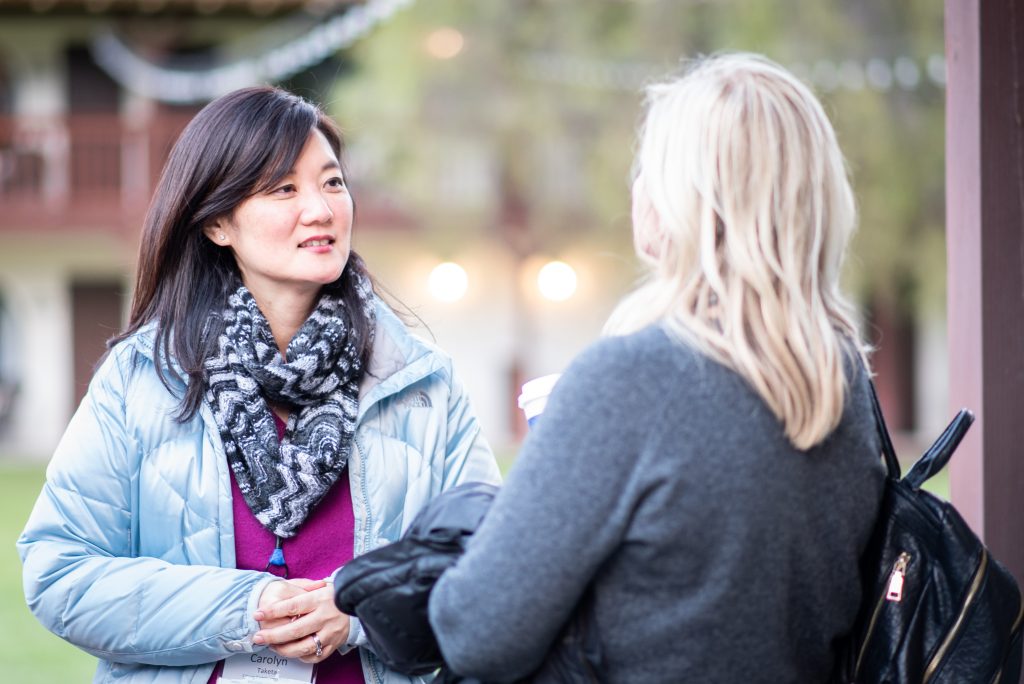
“What if I am not good enough? What if you are wrong about me? I may disappoint you,” said Jane.
I patted her on the back and let her inside the building. I gave her a big smile. She looked, awaiting my response.
“I’m fascinated right now. I can’t wait to learn how you do what you do. I hardly wanted to come to work today. Let’s see what we can learn from each other and teach the women.”
Jane gave a proud nod. We went into our meeting room and got right to work. Through the years, Jane continued to help facilitate empowerment groups. She eventually went to school, earned her bachelor’s degree, and became a victim advocate. She began to run her own groups, reminding other women of their skills and potential. Was it my group or teaching that motivated Jane? After all, I gave her the nudge. No. It wasn’t the group or me. Jane’s accomplishments were due to her tenacity. All she needed was a bit of inspiration from outside the world that held her captive for so long.
What are the issues at play here?
When working with victims of domestic violence, there are a few things we, as advocates, medical and mental health providers, counselors, and peer support, must remember. Victims of domestic violence are tired. They have been worn out by their abuser(s). They may not have the best attitude. They may not always be ready to take charge. Victims and survivors of domestic violence may feel like they are everything their abuser(s) said to them. They may not feel like they are enough. They might not believe they have the energy to keep going. They may think other people will be disappointed in them. Most importantly, they may not trust themselves. This can cause them to miss out on a lot of great opportunities.
What Can We Do?
Inspire them. There is often some quality in them that needs nurturing or inspiration. In Jane’s case, she was strong and had a motivation, her son. Many of the other women may be the same way. Sometimes, they need to be inspired and shown how it is done. Remember, they have been in their domestic violence bubble, surviving. When working with victims of domestic violence, we always have to shift their focus away from the narrative their abuser used against them. We can hone their best qualities and skills by shifting the focus. We, as practitioners and providers, can illuminate that spark. We don’t cause the light within them. It is there already. We remind them to shine and use their light to guide others.

SPRING 2026: A VOICE ON THE STAIRWAY
by Dr. Amber D. Chapman-Gray, PhD, DBH
Working in domestic violence prevention and intervention, an advocate can tell you countless stories about victims who impacted their lives. Some stories are so harrowing they leave a permanent imprint on the soul. Some are so disheartening they push providers out of the field forever. Professionals who work in victim services and advocacy hear and see a great deal of human suffering. Sometimes, however, you hear a story that reminds you exactly why you entered violence prevention and intervention in the first place.
One such story is the story of a woman named Edna.
(Note: Names, locations, and identifying details have been changed to protect the privacy and safety of all parties involved.)
Edna was a mother of two living in New Mexico. Every morning at 5:00 a.m., she woke up to prepare breakfast for her husband, Harry. She ironed his work clothes, filled a thermos with hot coffee, and kissed him on the cheek before sending him off to work. By 6:30 a.m., she was waking up her children, Lisa and Mark, laying out their clothes, preparing breakfast, and getting them ready for school.
The rest of her day revolved around maintaining the household. Cleaning. Running errands. Preparing dinner. Keeping everything in order before Harry returned home.
Edna did not want Harry to become angry.
If Harry had a bad day at work, the violence at home often followed. Something as small as an unwashed dish, dust on a television stand, shoes left out of place, or any perceived imperfection could trigger an explosive outburst. Over the years, Edna became hypervigilant, doing everything she could to prevent his violent flare-ups.
When she was younger, Edna tolerated the abuse more quietly. But as Lisa and Mark grew older, she became increasingly intolerant of the violence. Every incident deepened her resentment toward Harry, even when he apologized profusely afterward.
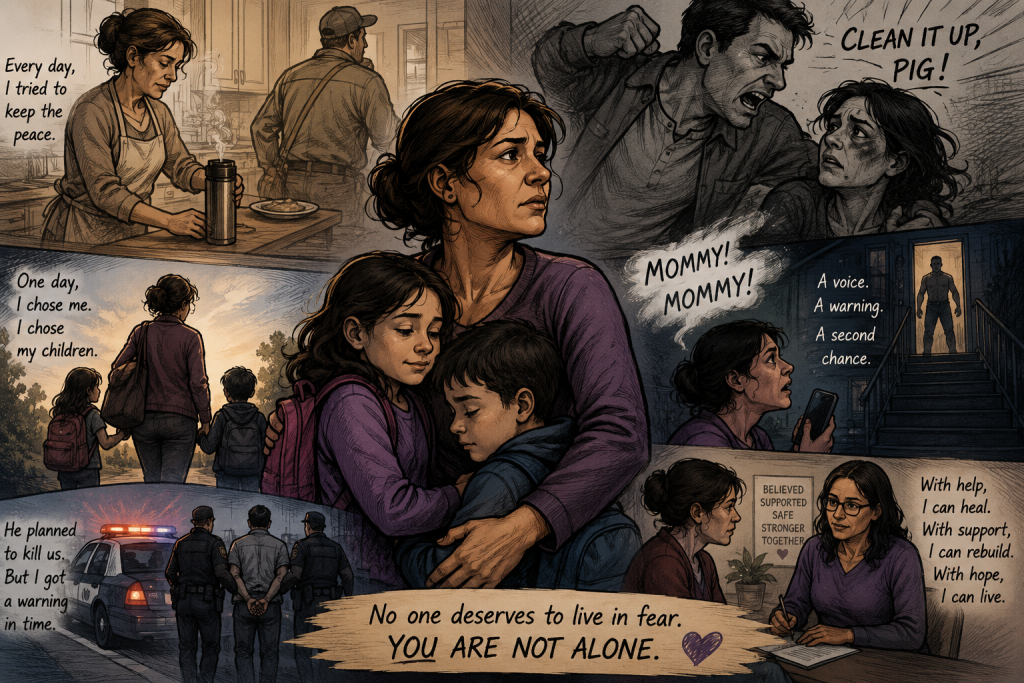
One evening, Harry came home furious.
He noticed the house was not clean. Dinner was unfinished. Edna looked exhausted and disheveled.
Harry stared at her with visible disgust before grabbing her arm.
“I work every day to come home to your lazy ass. Clean this pig pen up,” Harry snapped.
Edna looked back at him with tired eyes. She had been fighting off the flu for days.
“Harry, I’m sick. Give me a break,” she replied weakly.
Harry struck her hard across the face.
“CLEAN IT UP, PIG!”
In that moment, Edna decided she was leaving him.
It took several months to safely prepare. Eventually, she contacted a local domestic violence shelter and worked with a victim advocate to create a safety plan for herself and her children. Arrangements were made for emergency housing and transitional support.
When the time finally came, Edna left.
For a short time, she stayed with a friend while waiting for placement in a transitional living facility. For the first time in years, her routine had changed. She no longer woke up before dawn to prepare Harry for work. Her mornings were quieter now.
That morning, she focused only on getting the children ready for school.
After breakfast, Edna drove Lisa and Mark to school herself. She smiled and waved as they walked toward the building.
Under her breath, she whispered:
“I promise, Mommy will make it right. Next time, it will be better.”
Edna drove back toward her friend’s apartment. Following the advice of her advocate, she parked farther away from the residence to remain cautious and less visible.
She remembered something the advocate had told her:
“The first two years after leaving an abuser are often the most dangerous.”
Edna looked around carefully before walking toward the apartment stairs.
Then she heard it.
A faint child’s voice.
“Mommy.”
Edna froze in place midway up the staircase and looked around. No one was there.
She continued climbing the stairs.
Again, the voice came.
More urgent this time.
“MOMMY! MOMMY!”
A wave of panic swept through her body.
The voice sounded exactly like her son, Mark.
Edna gripped her chest and scanned the area frantically, but she saw nothing.
Then again:
“MOMMY!”
Edna turned and ran down the stairs toward her car.
“Mommy is coming, Mark! I’m coming!” she screamed.
As she reached her vehicle and turned toward the apartment building, she looked up.
Standing naked in the doorway of her friend’s apartment was Harry.
He was completely out of place.
He should not have been there.
Edna immediately grabbed her phone and called 911. The mysterious voice faded from her mind as terror consumed her thoughts. Why was Harry there? Where was her friend?
Law enforcement arrived quickly and arrested Harry at the scene.
Inside the apartment, officers found Edna’s friend, Gracie, bound and gagged inside a closet.
Police later informed Edna and Gracie that Harry had allegedly planned to murder them both and dismember Edna afterward. Investigators explained that Harry had removed his clothing to reduce forensic evidence and make cleanup easier after the crime.
Edna had survived.
But the trauma work ahead of her would be long and difficult.
As Edna sat across from me during intake, sharing her story through exhaustion and tears, I remember thinking:
This is why I do this work.
This is why advocates stay in violence prevention and intervention despite the emotional toll.
To be there for survivors.
To help pick up the pieces when someone’s world collapses.
To remind victims they are not alone.
No person should ever have to live in fear inside their own home.
As for the voice on the stairway, no one truly knows what it was.
Lisa and Mark were safe at school.
Perhaps it was intuition. Perhaps survival instinct. Perhaps fear manifesting into a familiar voice. Perhaps something spiritual. Whatever it was, it interrupted Edna’s routine long enough to save her life and bring her safely to our facility.
And sometimes, in this field, survival itself is the miracle.
Key Takeaways for Survivors, Advocates, and Providers
1. Leaving an abusive relationship can be the most dangerous period.
Many acts of stalking, severe violence, and intimate partner homicide occur after separation. Safety planning with trained advocates, shelters, and support systems is critical.
2. Coercive control often exists long before severe physical violence.
Domestic violence is not always visible bruises or injuries. Fear, intimidation, hypervigilance, degradation, and behavioral control are forms of abuse that deeply impact survivors and children.
3. Trauma changes the way survivors experience danger.
Survivors may experience heightened intuition, panic responses, dissociation, or overwhelming feelings that something is wrong. These responses are often connected to prolonged exposure to danger and survival conditioning.
4. Advocates and providers carry secondary trauma.
Professionals in victim services often absorb emotionally devastating stories. Support systems, supervision, peer support, and self-care are essential for sustaining long-term advocacy work.
5. Survivors deserve more than survival.
Every survivor deserves safety, dignity, stability, healing, and the opportunity to rebuild a life free from fear and coercive control.

By Dr. Amber D. Chapman-Gray
Author’s Note: Some identifying details have been changed to protect the privacy of survivors, children, staff, and the facility.
Content Warning: This story discusses domestic violence, serious injury, child trauma, and threatening language.
When you first start working in direct care, there are many times when you have to work various shifts. This is meant to help the provider get used to the different ways clients may respond during certain times of the day. You work mornings, swing shift, and nights to learn what goes on in the shelter.
It is hard to believe, but the most active part of shelter life often happens at night. When night falls, there are more hotline calls, more law enforcement drop-ins, more client incidents, and more unusual interactions. This story from the field is about a series of unsettling incidents that occurred with limited staff available.
It was fall at the shelter. The days were warm, but the nights devolved into a chill. The children in shelter happily attended school, aftercare, and then returned to engage in shelter routines and activities.
My boss assigned me to the night shift. It was my first time in a long time working nights. The shift ran from 5:00 p.m. to 7:00 a.m., a fourteen-hour shift that staff members often described as brutal.
A co-worker looked over at me and nudged me with her elbow.
“Don’t let the ghost of the desert shelter get you.”
She laughed with our other co-workers.
I gently swatted her away.
“I’m not afraid of a few night hours.”
It was true. I was not afraid.
Over time, the night shift became my shift.
I found being alone in the front offices at night re-energizing. I did not have the watchful eye of administrative staff constantly telling me to do this or that. I had some personal freedom, and that made me feel great.
My other night co-worker enjoyed spending her downtime on the breakroom patio. It was closed off, fresh air was accessible, and it made you feel as though you were not inside of a 160-bed facility.
That feeling would disappear the moment flashing blue and red lights from a police car pierced the dark night, bringing in a new person who had been beaten up by their significant other.
One night, as my colleague was smoking on the patio, she tapped on the breakroom door. I came over and looked. She pointed out into the darkness.
There, I saw the red and blue lights of an approaching police car.
I nodded.
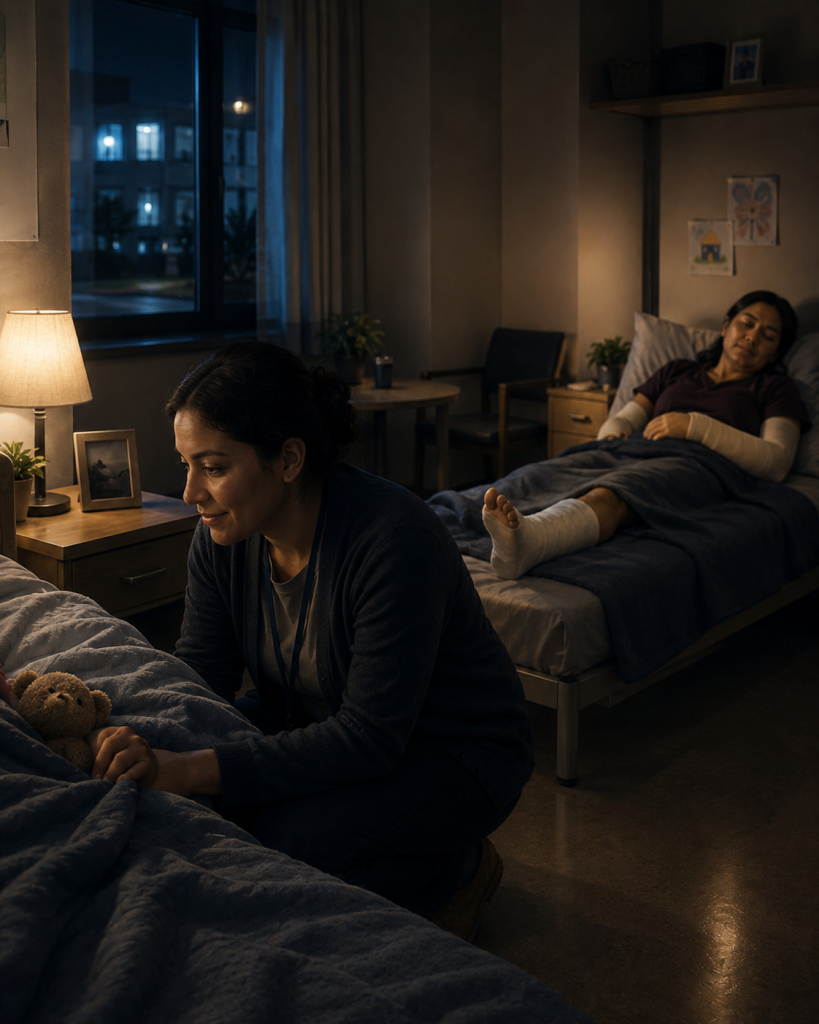
I went to the front of the shelter and allowed the officers inside. They had a woman with them who was fresh out of the hospital. Her arms were in casts, as well as her left leg. She had three small children with her: two little girls and one little boy who appeared to be about three years old.
The officers explained the woman’s situation to me, and I completed her intake. After the officers left, I led the woman to her new “apartment” inside the facility.
The woman looked at me and asked, “Where am I?”
I told her she was somewhere safe. I explained that the location was not on the maps, and that law enforcement patrolled the area roughly every 30 to 50 minutes.
The woman entered her space. She was surprised by the setup. Then she smiled.
I helped her into bed and got her children settled for the night.
There was nothing noticeable about the arrival of this particular client. I made the long trek back to the front offices, where my co-worker informed me that she was going to head home early. She did not feel well and planned to take a few days off.
I assured her I could hold down the fort.
After my co-worker left, I went into my office. My office was the center office in a rotunda of inner offices. I had a glass front window, and my office door was to the right. I could look out of my window to see if any of the women were coming down the long hallway into the office lobby.
By 1:30 a.m., the shelter was pin-drop silent. It was a slow night for a change. Law enforcement was not bringing anyone in for an emergency shelter stay. Our facility was not full that night either. Out of 160 beds, there were only about 50 families in shelter, including the new family.
I turned on some light classical music and worked on updating client files, creating behavioral reports, and completing data entry.
Around 2:00 a.m., when the shelter was at its quietest, I heard a noise near my office window.
I nearly jumped out of my skin.
The little boy from the new family was standing there, peering at me.
I thought he must have found the enclosed offices strange. I also thought he must have been happy to see an adult after making that long journey to the office lobby.

Then, suddenly, he did something unsettling.
He balled up his right fist and began punching his left hand, as if threatening that he was going to hit me.
I stood up and walked out of my office. I shook my head at him.
“No. No. We are going back to your place.”
He laughed with glee as I took him back down the long hallway, down the L-shaped corridor, and into the east wing where his apartment was.
Surprisingly, the door was shut.
How did his little self get all the way to the front offices? More importantly, how did he get out of the apartment?
I used my staff key to unlock the apartment door. I let him back in and sat him on the bed he was assigned to. His mother and sisters were sleeping.
He sat in his bed smiling at me.
That would not be the only time he did this.
The child startled me at my office window almost every night for six nights. He always balled up his little fist and hit his left hand at me.
It was always 2:00 a.m. on the dot.
On the seventh night, I decided to ambush him.
I hid just off to the right of my office. I saw him approaching from down the hall.
It was 1:58 a.m.
By 2:00 a.m., he stood at my office window, peering inside.
“Boo,” I said.
I startled him. He jumped, but then giggled wildly.
“Kid, this has got to stop.”
This time, rather than comply and walk with me back to his apartment, he balled up his fist and said, “It’s been too long, bitch.”
I picked him up as he stared at me blankly.
I took him back down the long hallway, past the L-shaped corridor, and into the east wing.
Surprisingly, his apartment door was open.
His mother was trying to sit up in her bed, but her injuries were not allowing her to do it with ease.
She peered at us and apologized immediately. She tried to stand, but then decided to remain seated.
“I’m sorry, staff. I knew he escaped. I can’t catch him in this condition. I don’t know where he is going. I was trying to figure out how to get up and get down to him.”
I explained everything the child had been doing.
She shook her head and told me that right as the bars were closing at 2:00 a.m., her husband would get home, ball up his fist, and threaten to hit her.
For almost a week, right before she was put in the hospital, her husband came home from the bar, balled up his fist, threatened to hit her, and said, “It’s been too long, bitch.”
Then he beat her, putting her in the hospital, where she was ultimately brought to our facility.
I stared at her little three-year-old son.
He looked at me and smiled.
I finally knew what he wanted.
I knelt down in front of him.
“You don’t have to worry. He can’t find you all here. You are safe. I’m always awake. I’m always watching. You don’t have to do anything but sleep. I’ll watch for your dad, and I’ll make sure he doesn’t get you all.”
Then I gave him a little hug.
Each night after that, as night fell, I stopped by his room and gave him the same speech.
Then I waited in my office for him to show up, balling his fist at me.
But he stopped coming.
I think he realized the threat was over.
And now, instead of being worried at 2:00 a.m., the child was able to sleep by nightfall.
Key Takeaways from “Nightfall”
- Children do not just witness domestic violence. They absorb its patterns.
Children may not have the words to explain what they have seen, but their behavior can reveal what their nervous system remembers. - Repeated behavior is often communication.
The child coming to the office every night at 2:00 a.m. was not “acting out.” He was communicating fear, memory, and a need for reassurance. - Safety is not always believed the first time it is offered.
For survivors and children, safety may have to be repeated, shown, and proven over time. One kind statement may help, but consistency is what teaches the body to rest. - Children may reenact what they cannot understand.
The child’s gesture and words reflected what he had seen and heard. This does not make the child violent. It shows how trauma can echo through behavior. - Shelter work requires observation, patience, and emotional steadiness.
Advocates and shelter staff often notice small details that matter. A hallway, a repeated time, a gesture, or a phrase may help reveal what a family has survived. - Healing can begin with one trusted adult staying calm.
The staff member did not punish, shame, or frighten the child. She reassured him. She gave him a new message: you are safe, you can sleep, and someone is watching over you.
Trauma-Informed Points to Remember
Trauma-informed care asks, “What happened to you?” rather than “What is wrong with you?”
The child’s behavior could have easily been misunderstood as defiance or aggression. A trauma-informed response recognized the behavior as a survival signal.
Regulation comes through relationship, repetition, and safety.
The child stopped coming to the office not because he was corrected, but because he was reassured. The repeated message of safety helped his body understand that the danger had passed.