
Gray’s Trauma-Informed Care Services Corp
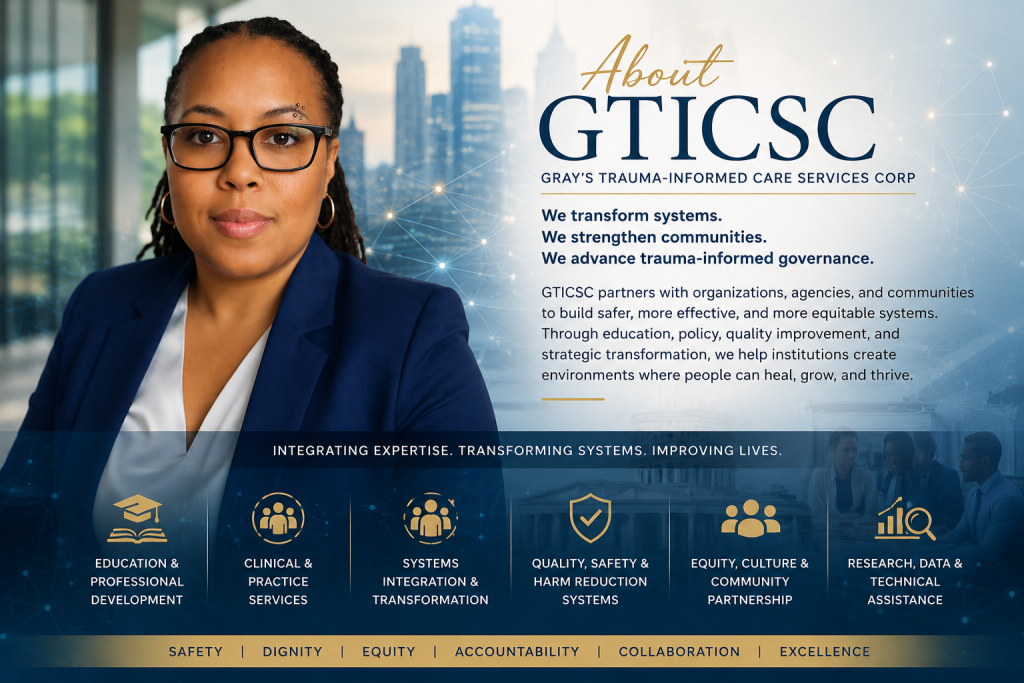
Founded in 2017, Gray’s Trauma-Informed Care Services Corp (GTICSC) is a trauma-informed governance, workforce development, and systems transformation organization dedicated to helping institutions create safer, more effective, and more equitable environments for the people they serve.
GTICSC was established in response to a growing recognition that trauma affects every sector of society, not only behavioral health and mental health services, but also healthcare, education, public safety, victim services, social services, community organizations, and government systems. While many professionals receive extensive technical training in their respective fields, they often receive limited preparation in understanding the impact of trauma, adversity, violence, chronic stress, and systemic inequities on the individuals, families, and communities they serve.
At GTICSC, we believe trauma-informed practice extends beyond individual interactions. Trauma-informed organizations must also examine the policies, procedures, leadership structures, quality systems, and governance practices that shape service delivery. For this reason, our work focuses not only on professional development, but also on transforming systems, strengthening institutions, and improving outcomes through evidence-based organizational design.
Our approach integrates trauma science, behavioral health, integrated care principles, organizational development, quality improvement, Lean Six Sigma methodology, equity-centered practice, and public systems transformation. Through these disciplines, we help organizations improve service quality, reduce preventable harm, strengthen workforce competence, enhance collaboration, and build sustainable systems that support both providers and the communities they serve.
GTICSC operates through six interconnected service areas:
- Trauma-Informed Education & Professional Development
- Clinical & Practice Services
- Systems Integration & Public Sector Transformation
- Quality, Safety & Harm Reduction Systems
- Equity, Culture & Community Partnership
- Research, Data & Technical Assistance
These service lines allow us to support organizations at every level of change, from individual workforce development to agency-wide transformation and multi-system collaboration.
Our work is guided by a comprehensive Four-Model Architecture that integrates trauma-informed teaching, coordinated systems design, quality and safety science, and trauma-informed governance. Together, these models provide a structured framework for building organizations that are efficient, effective, equitable, accountable, and responsive to the needs of diverse populations.
GTICSC partners with healthcare organizations, behavioral health providers, educational institutions, victim service agencies, community-based organizations, nonprofits, municipalities, counties, and public sector agencies seeking to strengthen services and improve outcomes. Whether supporting a single program or a large-scale systems transformation initiative, our focus remains the same: helping organizations create environments where safety, dignity, collaboration, accountability, and equity are embedded into everyday practice.
We recognize that meaningful change requires more than training alone. Sustainable transformation occurs when leadership, workforce development, policy, operations, quality improvement, and community engagement work together toward a shared vision. Our role is to help organizations build that foundation.
At Gray’s Trauma-Informed Care Services Corp, we envision a future where trauma-informed governance becomes the standard across public systems and community institutions; where services are designed to reduce harm rather than inadvertently create it; where professionals are equipped with the knowledge, skills, and support necessary to succeed; and where every individual is treated with dignity, respect, and humanity.
Through education, consultation, technical assistance, research, and systems transformation, GTICSC remains committed to advancing safer systems, stronger communities, and a more equitable future for all.